tagged  2017, Business Books, Management, Time Management, leadership, productivity in Effectiveness
2017, Business Books, Management, Time Management, leadership, productivity in Effectiveness 

Tuesday, January 10, 2017 at 7:41PM 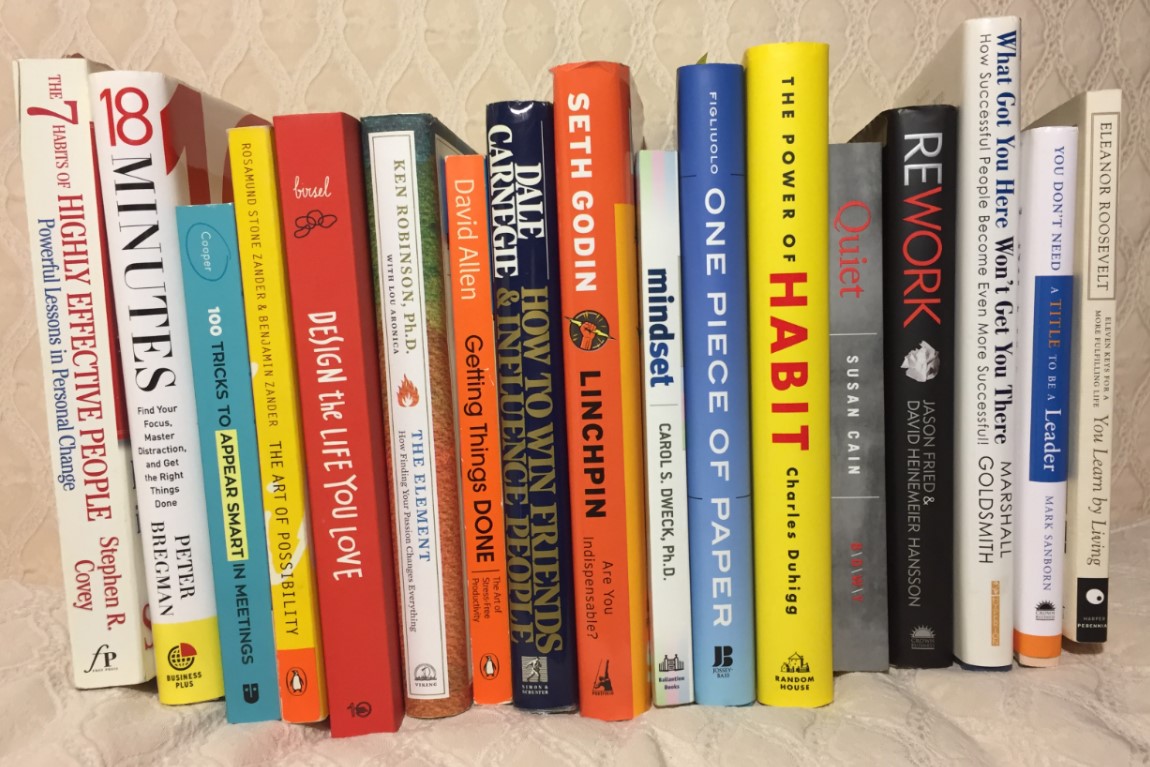
Every new year it’s the same thing. We start out with good intentions, high hopes, and a formidable list of potentially life-changing resolutions. And for an indomitable few, those resolutions get carried through and result in a laundry list of transformational changes and positive outcomes by the end of the year.
But for most us, despite our very best intentions, life tends to get in the way. Before we know it, January is over and February flies by (it’s such a short month!). Then all the spring holidays come along. Then it’s summer, and…well, you know the rest. That pledge to “start tomorrow” just leads to the eventual realization that today is yesterday’s tomorrow and we haven’t even gotten out of bed yet. So, what can we do about it?
We can start today. For real. Right now. What we need to do is go from “resolutions” to “real solutions”! And one real-life solution that really works, is easy to do, and can kick-start us into action, is to start reading!
And my recommendation – if you are really serious about, and dedicated to, improving your life this year – is to start your New Year by reading any one of the following 17 inspirational and impactful books on this list.
My Selection Criteria
There are a million business and self-help books on the shelves, so why these?
Because these are all written for – and about – YOU. Each of these chosen selections is practical, actionable, and even, yes, pleasurable to read. While there is a time and a place for heavy academic research and serious business case studies, these selections are all relatively easy-to-read and intended for the single purpose of helping you to become the best “you” that you can be – in work and in life.
I read (and/or re-read) an average of 5-10 business books a month on topics ranging from management and leadership to teamwork and innovation. But the books on this list are more related to personal and professional productivity, and are intended to help you to discover your passion, figure out what makes you tick, overcome your obstacles, conquer your fears, and spur you to action. They’ll help you to get focused, more effectively manage your time, and provide you with a number of powerful and innovative ways to maximize your Performance, your Productivity, and your Potential (what I call the “Three Ps” of success).
Yes, I know you’re busy working. Or going to school. Or looking for work. Or all three. And you’re exhausted – physically, mentally, emotionally, and spiritually. And it’s so much easier and more relaxing and fun to just kick back on the couch and binge watch back-to-back episodes of “Game of Thrones,” “Mr. Robot,” “The Walking Dead,” or “Orange is the New Black.” But if you’re really serious about making a change, and taking your career – and your life – to a whole new level this year, think about the potential ROI (Return on Investment) that making the time, and taking the time, to read just one – ANY ONE – of these books could potentially bring!
My 2017 List
While some of these title are newer releases, others are what I consider either recent and/or timeless classics. Every one of them (listed here in alphabetical order) have had an impact on me both personally and professionally, and are among my regular, go-to favorites that will, hopefully, “Educate, Engage, and Excite” you, as much as they did me. While most of the 50-plus new business books I read each year simply end up on the shelf afterwards, these are among the special few that I keep within arms’ reach for regular, repeated reference all year ‘round:
1) 7 Habits of Highly Effective People, The: Powerful Lessons in Personal Change (Stephen R. Covey): When people ask, “What’s the ONE book I should read to become more effective and productive?” this timeless bestseller is the one. At the very least, even if you don’t choose to read the whole book cover-to-cover, everyone should at least know what those seven habits are. (For your convenience, here they are.)
2) 18 Minutes: Find Your Focus, Master Distraction, and Get the Right Things Done (Peter Bregman): If time management, prioritization, and personal productivity are a challenge, this new book by master storyteller, Peter Bregman, will help you get your life on track and start producing results. (See the Bregman Box on page 118).
3) 100 Tricks to Appear Smart In Meetings (Sarah Cooper): Is it more important to BE smart, or to APPEAR smart? This hilarious and entertaining illustrated book will help you to do both. While in some ways more of a humor book than a business book, there are real work-related observations and insights on every page. Disclaimer: If you don’t have a sense of humor or don’t find anything about work meetings to be in any way funny, you may want to just skip this one.
4) Art of Possibility, The: Transforming Professional and Personal Life (Rosamund & Benjamin Zander): Indescribably brilliant and inspirational storytelling by this husband and wife team. I re-read this book from cover-to-cover once a year. (Watch his famous TED Talks.)
5) Design the Life You Love: A Step-by-Step Guide to Building a Meaningful Future (Ayse Birsel): A beautiful, thought-provoking, interactive, and inspirational workbook that will take you on a journey of discovery by applying design principles to your own life. And if you ever have a chance to attend one of the author’s wonderful, life-changing workshops, I would highly recommend it!
6) Element, The: How Finding Your Passion Changes Everything (Dr. Ken Robinson): When who you are and What you do are in alignment and harmony, you are “in your Element.” This book will help you get there. (His RSA animated video is a true classic.)
7) Getting Things Done: The Art of Stress-Free Productivity (David Allen): If you are simply looking for a straight-forward, no-frills, systems-based approach to getting yourself organized, getting yourself moving, and getting things done, this is the number one book out there on the subject of personal and professional productivity. (Tons of tools on his GTD website.)
8) How to Win Friends & Influence People (Dale Carnegie): This, the first-ever “self-help” book, is the one that started it all. Written in 1936, this book has, literally, changed millions of lives worldwide. Now it’s your turn. The title says it all.
9) Linchpin: Are You Indispensable (Seth Godin): I absolutely LOVE this book by one of my all-time favorite thought-leaders. In today’s working world, we need to consistently find ways to add value and stand out in a crowd. This brilliant book will inspire you to overcome your “lizard brain” and create your own path to success. I’ve read at least 15-20 of Seth’s books; every one an innovation and an inspiration. This is the one that had the biggest impact on me. (For a taste of Seth's work, subscribe to his daily blog which will change the way you see the world on a daily basis.)
10) Mindset: How We Can Learn To Fulfill Our Potential (Carol S. Dweck, Ph.D.): This is the book that put the terms “growth mindset vs. fixed mindset” on the map, and shows us how understanding the important distinction can enable us to shift our mindset and unleash our potential…as well as that of others. A powerful and valuable resource for business people, teachers, parents, and everyone else.
11) One Piece of Paper: The Simple Approach to Powerful, Personal Leadership (Mike Figliuolo): What if you could capture, on a single sheet of paper, in meaningful maxims, your own personal guide to leading yourself, leading the thinking, leading others, and leading a balanced life? This creative and interactive book will help you do just that! (Full/proud disclosure: My “leadership self-awareness” guest post made his Top Ten list in 2012!).
12) Power of Habit, The: Why We Do What We Do In Life and Business (Charles Duhigg): Whether trying to break an old habit or start a new one, this book will help you transform yourself into the person you would like to be through gaining a better understanding of how habits work…and what it takes to break the bad ones and start some better ones.
13) Quiet: The Power of Introverts in a World That Can’t Stop Talking (Susan Cain): Finally, someone has given us introverts a voice! This book (targeted both towards introverts AND extroverts) is the definitive work on what introversion is really all about. Also, check out Susan’s inspirational TED talk that put her on the map.
14) ReWork (Jason Fried & David Heinemeier Hansson): Like Godin’s “Linchpin,” this book cuts through the crap and tells it like it is. Written with humor, attitude, and artistry, these guys get you to look at the world of work in a fresh new way.
15) What Got You Here Won’t Get You There (Marshall Goldsmith): One of my top ten favorite business books of all-time, this classic work reveals the twenty bad habits we need to break...and how to break them so as to become even more successful. I also highly recommend a number of his other titles including “Mojo,” and “Triggers: Creating Behavior That Lasts.” Also check out his website for numerous valuable videos and other generous resources.
16) You Don’t Need a Title to Be a Leader: How Anyone, Anywhere, Can Make a Positive Difference (Mark Sanborn): This quick-and-easy-to-read, 100-page book of simple stories will encourage and inspire you to step up to leadership – regardless of your role, position, or title. I love this powerful little book and re-read and reference it all the time.
17) You Learn By Living: Eleven Keys For a More Fulfilling Life (Eleanor Roosevelt): An inspirational work by an amazing woman who was way ahead of her time. Among the many life lessons she passes along in this powerful memoir is one of her most famous quotes: “You gain strength, courage, and confidence by every experience in which you really stop to look fear in the face... You must do the thing you think you cannot do.”
So that’s it. Again, there are many other great books out there that can help you to increase your effectiveness, but as the wealth of options is seemingly unlimited and somewhat overwhelming, this list of personal favorites is intended to answer one of the most commonly-asked questions I get both from my coaching clients and from my students: Where should I start?
So just pick ONE and dive right in. You might even happen to have a few of the bestselling classics already piled up on your nightstand gathering dust, or sitting on your bookshelf. But remember that BUYING the book with the best of intentions – as so many people do – is not enough; you need to actually READ it to reap the benefits. That’s obvious and common sense. But, as the saying goes, “Common sense is not always common practice,” and industry research tells us that a large majority of business books purchased are never even opened, let alone finished.
As Harry Truman said, “Not all readers are leaders, but all leaders are readers.” So if you truly want to lead, you probably should start to read.
One Final Important Tip
After you finally sit down and crack the cover, don’t just skim through it: Really read it, devour it, interact with it, engage with it, absorb it, consume it, and make it your own. Business reading should not be a passive, but an active – and even an interactive – experience. Yes, that takes “work”; but you have to do the work if you want to reap the benefits:
If you’re really serious about turning your New Year’s “resolutions” into the “real solutions” mentioned earlier, I hope you will take me up on this challenge, pick up any one of these books, and dive right in. And let each book on this list be a spark that ignites your passion and inspires you to set the world on fire in 2017.
For some of my other top book recommendations (as if this list isn’t enough), please see:
15 Fascinating Books to Help You Become a Better Thinker
14 Books That Will Make You More Innovative
END
2017, Business Books, Management, Time Management, leadership, productivity in Effectiveness Friday, June 24, 2016 at 6:04PM 
The classic Gershwin song reminds us each year around this time that it’s “Summertime, and the livin’ is easy.” While those “fish are jumpin’,” the pace at work tends to slow down; the office dress code tends to get more casual; bosses, co-workers, and clients disappear on vacation; and most everyone tries to sneak out early on Fridays.
So, you’re thinking: Why not join the club, chillax, and shift into cruise control for the next couple of months?
But instead, what if, this summer, you decided to shift gears and do the opposite!
While everyone else is out getting their second Mister Softee or third iced coffee of the day, why not carpe the diem and take at least some of this downtime to do some of those things that you’ve been putting off all year long? That is, instead of cruising through the summer and then wondering where the time went, why not put the pedal to the metal, and take advantage of these lazy, hazy, days of summer to get ahead.
How? By – in addition to, of course, allowing yourself to take some well-earned and much-needed time off for yourself – you may want to consider dedicating at least a few of those dog days of summer – the period between the Fourth of July and Labor Day – to focus on these four incredibly imporant and impacful career-enhancing activities:
The Time Management Matrix model I mentioned in a previous post (“Start the New Year Off Right with 7 Simple Productivity and Time Management Tips“) demonstrates that we spend most of our time in either Quadrant 1 (Urgent & Important tasks) or Quadrant 3 (Urgent and Unimportant tasks). For good reason, it’s often referred to as “the tyranny of the urgent” because we let external demands and time constraints dictate where and how we spend so much of our time.
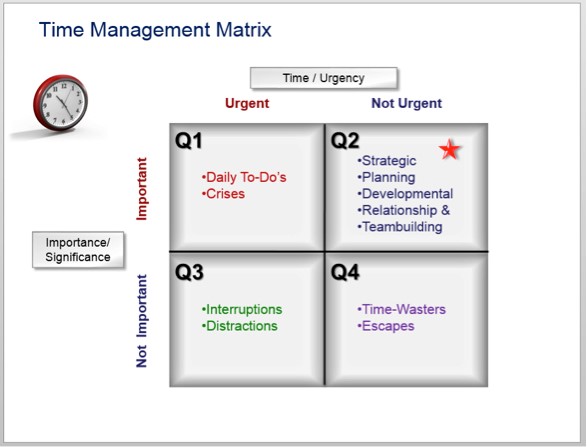
But with things slowing down a little and often with fewer Q1 & Q3 fires to put out, summertime just might be the right time to focus on Q2 (Important, but Non-Urgent tasks and projects)…and even allow us to spend some Q4 downtime (Unimportant, and Non-Urgent) on ourselves.
So regarding those four developmental areas I listed earlier, which quadrant do they fit into? Yes, Quadrant 2!
Q2 is where the bigger picture, longer term, strategic, and developmental things happen. So, developing ourselves, developing our relationships, developing our people, and developing our teams are four high-payoff activities that often end up on our Wish List rather than on our To-Do List. Why? Because, by definition, though they are of high importance, they simply are not “urgent”…and it is the urgent and time-sensitive things that tend to command our attention and dictate our calendars, often leaving us with no time, or energy, to spend in the all-important Quadrant 2.
And what about Q4 – the unimportant and non-urgent? Well, we cannot live by work alone! There is definitely a need to recharge and refresh ourselves mentally, physically, emotionally, and spiritually. And summertime is the perfect time to try to carve out some time to do that. After how hard we work throughout most of the year, don’t we owe it to ourselves to take advantage of this downtime…and the beautiful weather? And, though Q4 activities are often categorized as “Time-Wasters and Escapes,” as the saying goes, “Time you enjoy wasting, is not wasted time.”
YOUR SUMMERTIME Q2 & Q4 TO-DO LIST
So, to help you seize the day and develop yourself, your relationships, your people, and/or your team this summer, here are just a few of a potentially unlimited number of possible suggestions that you may wish to consider adding to your summertime To-Do list:
[1] DEVELOP YOURSELF
While racing to get your work done throughout the year, it’s very easy to forget about working on yourself. So make the time and take the time this summer to get organized and to create processes and systems that will help you to be more efficient and effective and productive. Here are just a few suggestions to help you develop yourself this summer:
[2] DEVELOP YOUR RELATIONSHIPS
Initiatiating conversations with your co-workers will not only increase your knowledge, but will help you to develop and strengthen those relationships. As the saying goes, in the business world it’s not just what you know…but who you know – as well as who wants to know you. And as the best way to be seen as “interesting” is to BE “interested,” seek to ask questions and make an effort to get to know people on a sincere, genuine, and human level. A few ways to build your network and deepen your relationships this summer:
[3] DEVELOP YOUR PEOPLE
The biggest objection I get when trying to sell clients on my training services is not “We don’t have the budget,” but “We just don’t have the time.” Unfortunately, the reality is that “NOW” is never a good time. So if you sincerely want to develop your people, you simply have to make the time, and the commitment, to do so. If you truly want to attract, retain, engage, and motivate your people, one of the best ways to do that is to invest in their personal and professional development. And summertime just might be a great time to squeeze in some training, coaching, mentoring, and more:
Btw, while some managers ask, “What will happen if we invest in developing them and they leave?” the other question to consider is, “What will happen if we DON’T, and they stay?”
[4] DEVELOP YOUR TEAM
Developing each individual in your organization is the first step, but when you develop people to become a more high performing team, you’ll find that as a T.E.A.M. – Together Everyone Achieves More. As I wrote in my post, “Team BONDING Needs To Come Before Team BUILDING,” to build a championship team takes time and attention. Time that you may be able to take advantage of during the summer:
While there are a million more possibilities, I’ll stop here. If you have other ideas, please share them with us!
In closing, as the inspirational magnet on my refrigerator advises: “Do something today that your future self will thank you for.” Which implies that if you do just some of the things listed above, your “September Self” will appreciate and thank your “Summer Self” for setting you up for a successful remainder of the year.
And again, while you’re busily making progress on your Q2 to-do list, remember to also take some Q4 time to reward yourself…especially if or when you hear that hypnotic and mesmerizing Mister Softee theme song calling your name.

coaching, personal productivity, planning, summer in Careers, Coaching, Effectiveness Tuesday, November 25, 2014 at 3:26PM 
Why is feedback—whether it’s negative feedback or constructive criticism—so tough for most of us to take?
When we receive feedback that we don’t agree with, the tendency is to get defensive, to explain, to make excuses, to try to invalidate it, to deny it, to be offended by it, and even to resent the person giving it.
Continue reading below to to find out why that is -- and what we can do to be better at -- and make the most of -- the feedback we receive.
`````````````````````````````````````````````````````````````````````````````````````````````````
My recent post on the Feedback Sandwich technique prompted a few readers to ask questions like this:
Most articles on feedback focus on how to deliver it more effectively, but what about when you’re the one on the receiving end? Do you have any tips on how to be better at receiving feedback?
Ah . . . that’s a good one. And a tough one.
Speaking for myself, I love getting criticism and feedback, and am completely open to receiving it any time, any place…as long as it’s positive and complimentary. When it’s not . . . um . . . let’s just say that I’m not quite as receptive. Nor are most people.
Why is that? Why is feedback—whether it’s negative feedback or constructive criticism—so tough for most people to take? When we receive feedback that we don’t agree with, the tendency is to get defensive, to explain, to make excuses, to try to invalidate it, to deny it, to be offended by it, and even to resent the person giving it.
Your Brain at Work
I just finished reading an amazing book, Your Brain at Work, by David Rock, who explains the neuroscience behind why we react emotionally (and sometimes irrationally) to feedback that we don’t agree with or don’t want to hear.
In brief, our primitive brains are biologically wired to perceive feedback as a threat. Not to get too technical or neurological, but the amygdala—the fear center (referred to often by author Seth Godin as our “lizard brain”)—intuitively senses feedback as a threat and does anything possible to avoid it.
Rock compares the feelings that feedback triggers to that sick-to-the-stomach, hair-standing-up-on the-back-of-your-neck fear you might experience when walking alone down a dark, scary alley and hearing footsteps quickly sneaking up behind you. The sensation that we are about to be attacked. The feeling that our lives are in mortal danger. That’s what feedback can feel like. And when we receive negative feedback, we are, in fact, at risk, especially when we feel our confidence, our self-esteem, and our sense of self are under attack.
It’s the “fight, flight, or freeze” response in action. That’s why, when receiving negative feedback (or sometimes even positive and constructive feedback), we may respond by lashing out in defensiveness, running (or storming) away, or standing there, speechless, in shock and disbelief.
The Five Threats
David Rock's now-classic acronym, SCARF, clearly and effectively captures the five ways that feedback may serve to threaten our state of being:
Status: Getting feedback may feel as if we are being spoken down to and that our status or position relative to that other person is being threatened. A boss’s saying something as simple as, “I need to see you in my office” can trigger a feeling of heart-stopping terror . . . and make you feel two feet tall.
Certainty: When we receive feedback, especially if it is unexpected, it could create feelings of uncertainty and confusion. You thought you did such a great job on that presentation, but now the feedback has made you doubt your abilities and shaken your self-confidence.
Autonomy: When we receive feedback that puts into question the decisions and choices we’ve made, not only might we start to doubt our own judgment, but we may now fear that our freedom and empowerment might be taken away.
Relatedness: When we receive feedback from someone, it could impact our relationship with that person. “How could you say that? I thought you liked me. I thought you were on my side. Is that what you REALLY think of me?”
Fairness: Have you ever received feedback from someone and felt misjudged, misunderstood, or unfairly evaluated? If you’ve had the reaction “That’s just not fair. That’s not true. You’ve got me all wrong!” then you know how it feels to have your sense of fairness threatened.
So, now that we know WHY feedback might be perceived as a threat to our personal well-being, and that it’s a completely natural, neurological, biological response, what can we do about it?
Making Feedback Work for You
1. Try to keep an open mind, consider the source and the intention, and keep things in perspective. Don’t react or overreact; just take the feedback in. With the self-awareness you now have about WHY feedback feels like an attack, it might be a little easier (over time, with practice!) to be more open to receiving the feedback objectively.
2. Though it’s natural to react emotionally (especially when under stress), try not to get defensive. Even though it may feel like you are being attacked when the feedback’s coming from multiple people simultaneously, be open to the feedback, let it settle in, and then decide what you want to do with it.
3. Feedback is a source of knowledge. Though some things may be difficult to hear or to admit, keep in mind the value of knowing. If you were about to go on stage to deliver a presentation, and you had a “Kick Me” sign on your back, toilet paper stuck to your shoe, and your fly was open, wouldn’t you be better off knowing than not knowing? At least now you can do something about it.
4. When you get vague, general, ambiguous feedback (e.g., “You need to do much better next time”), seek out specifics. Ask for suggestions on how you might improve. Confusing feedback is worse than no feedback at all. You could even request that the person start with something positive before getting to the constructive criticism. Encourage them to use the Feedback Sandwich with you!
5. Change your mindset about feedback. Reframe it as a developmental opportunity rather than a criticism of you personally. Recognize that while the tendency (basic human nature) is to focus on the negative, it is equally important to validate your strengths and leverage what you’ve done well.
6. After receiving feedback, take some time to let it sink in, and think strategically on what to do with it and where to go from here. Remember: Unless something is a real emergency that is causing serious, immediate problems, you don’t have to change or fix everything—or anything—overnight! In fact, it’s almost impossible. Continuous improvement is an on-going process and a lifelong journey. And feedback is a mechanism that will help you to stay on course and moving ever-forward. Without it, how will you know how well you’re doing?
The Gift
There’s an old saying that “Feedback is a gift.” And like any gift we receive, we can choose to toss it in the trash, or we can appreciate the thought behind it. Perhaps when we unwrap that gift, when we have a chance to sit alone with it and ponder it, we’ll find a nugget of truth hidden somewhere inside that box; one that we need to seriously consider.
And, if that is the case, that feedback is, indeed, a gift, very often the best, and the only, response necessary, is these two simple words: “Thank you.”
Friday, October 17, 2014 at 12:05AM 
“All the world’s a stage, And all the men and women merely players; They have their exits and their entrances, And one man in his time plays many parts, His acts being seven ages…” ~ Shakespeare
When anyone – including my coaching clients and grad students – asks me for career advice, my answer is always the same:
“It depends!”
And what does it depend on? A lot of different, individual factors. But among the most important is, where are they in terms of Shakespeare’s “seven ages”…and at what stage are they in their career?
While there is, of course, no “one-size-fits-all” answer to the question, “What career advice do you have?” based on my own, subjective and personal experience, here’s my best career coaching advice for every age and every stage:
Teens: The Age of Exploration
When you are in your teens, you don’t know what you don’t know. Try to gain exposure to as many different experiences as possible so as to learn more about the realities of the workplace and to get an idea of what you may be good at and what you’re not, as well as what you may like to do and what you don’t. Don’t be afraid to try or to fail. That’s what these years are for. Find internships, take temp jobs, entry-level jobs, do volunteer work, and ask questions. Lots of questions. Don’t feel that any question is dumb, or that any job is beneath you. At this stage of your life, everything is a learning experience. Just go into it with a positive attitude, and you’ll be amazed at how much you can learn and how much, and how fast, you will grow.
20s: The Age of Experimentation
Now that you have a better sense of what’s out there, take a more targeted approach toward finding your niche. You are still exploring and experimenting, but the stakes are a little higher now than when you were still in school. You want to do well, gain experience, build your network, and show that you are capable of producing real results. Take chances, but be smart about it. And don’t burn any bridges or do anything rash that could potentially come back to haunt you one day (including what you put out there on social media). You are now establishing your reputation, building your resume, planting the seeds for your career, and – as Steve Jobs put it – asking yourself how you are going to “put a ding in the universe.”
30s: The Age of Self-Actualization
At this point in your life, there is, hopefully, some connection between who you are and what you do, as well as having developed a strong sense of your “personal brand.” One way to explore what your personal brand is is to think about your answer to the question: “What do you want to be known as ‘the Guru of’ or ‘the Go-to person’ for?” And then figure out what you need to do to make that vision a reality. Ideally, you want to be working at what you are good at (and/or aspire to be great at) and what you like or love to do. You want to be setting yourself up for success and becoming a subject matter expert in your field, while still creating opportunities to take risks and to grow. You may have greater “adult responsibilities” now, so it may also be time to start thinking about and preparing for the future — financially and otherwise. The key is to be proactive in figuring out what you need to do to maximize your performance, your productivity, and your potential, both in your career and in your personal life.
40s: The Age of Expertise
Ideally, you’d like to now be settled into a career in which you’ve established a proven track record of success based on producing tangible results, as well as having developed a positive professional reputation and a network of contacts. (And not just online “connections,” but true, real-world relationships.) Building on the results you’ve produced, and with an eye toward the future, very often at this stage your thoughts turn to further developing your leadership potential while continuing to hone your personal brand — both internally within your firm and externally within your industry.
But what do you do if you’ve had a setback and/or your career train has gone off the track? My feeling (from personal experience) is that it’s never too late to reinvent oneself. As the saying goes about best-laid plans, they often go awry. And, as in a board game in which you get knocked back to the starting square, you may need to go back to the Ages of Exploration and/or Experimentation again and start anew. And, if so, keep in mind that there’s absolutely nothing wrong with that (!), as it happens to most of us at one point or another. The good news, however, is that this time around you get to leverage the wisdom of your experience as you set out in search of new horizons and new possibilities.
50s: The Age of Mastery
Here’s where and when you want to leverage your many years of experience to establish your reputation as a credible subject-matter expert in your field. You’ve earned it. But it’s equally important to keep learning! Remember that “In an ever-changing world, if you’re standing still you’re falling behind.” Everything today – technology, the marketplace, expectations – changes quicker and more frequently than ever. The shelf-life of knowledge in this day and age is shorter than the expiration date on a container of milk. So it’s a never-ending, 24-hour-a-day race just to keep up. But you must, as there is no other choice if you wish to stay relevant and be seen as valuable. Your strength, at this stage, lies in combining your years of experience with your ability and willingness to proactively stay ahead of the curve. At this stage, you may also be thinking about what you want your “leadership legacy” to be…and, therefore, think seriously about what you need to do between now and the future to make that vision a reality.
60s +: The Age of Wisdom
You’ve seen it all. Or have you? With things these days changing faster than ever, we see something else we've never seen before. You want to make yourself marketable by branding yourself as a sage, and yet have the humility to look to those younger than you as your teachers. You want to be a mentor, and yet be open and willing to be mentored. With that combination of attributes, you will have much to contribute and be much in demand. You want to experience the satisfaction of continuing your own personal and professional journey of growth and development while, at the same time, taking the time to -- and taking pride in -- passing the wisdom of your experience along to the next generation, keeping in mind the maxim that “Wisdom is where Knowledge and Experience meet.”
A Few Final Words
Please bear in mind that this is all just one person’s totally subjective, general advice, and you are entirely free to agree or disagree. And there are no “shoulds.” Career paths take us where career paths take us. Just as in Robert Frost’s “The Road Not Taken,” our career journeys are ultimately made up of the combination of the choices we made…and the choices we didn’t. The reality of today’s workplace is that careers are rarely a straight “path” but more of a roller coaster ride of ups and downs, starts and stops, twists and turns, and victories and setbacks.
So, with that in mind, to me the keys to a successful career journey include a life-long love of learning, proactivity, resilience, a positive attitude of gratitude, and a growth mindset that keep you continuously looking – and moving – ever forward…at every age, and through every stage.
Careers, Generations, Millennials, advice, coaching, leadership in Careers, Communication, Effectiveness, Job Search Tuesday, March 4, 2014 at 8:47PM 
One of your co-workers gets so much work done in a day it makes your head spin, but she tends to steamroll over everyone in the process.
Another co-worker is great with details and never misses a trick, but he tends to over-analyze everything and takes forever to make a simple decision.
One of your other co-workers is a nice person and a great listener and teammate. But by trying to please everyone, she fails to please anyone.
Yet another is always enthusiastic, fun to work with, and has a million ideas. Too bad he’s all over the place and never seems to follow up, follow through, or finish anything.
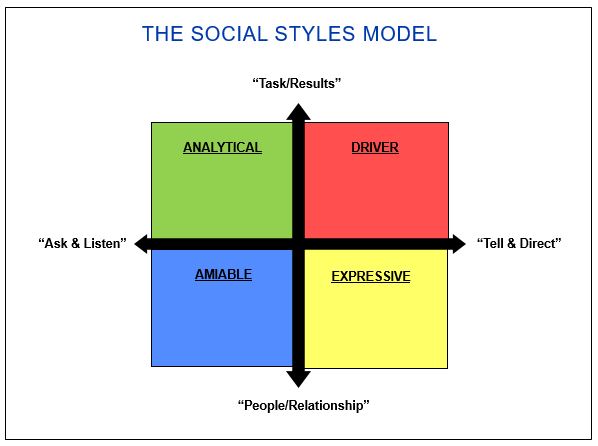
In their classic “Social Styles” model, Robert and Dorothy Bolton labeled the four personality types mentioned above as: Driver, Analytical, Amiable, and Expressive. Of these four types, which person would you most prefer to work with and why? Which one drives you insane? And, perhaps most importantly, which one are YOU?
1. Driver
“Let’s go! Let’s get the job done right now!” She is direct, decisive, and determined. She loves a challenge, is willing to take risks, works at a fast pace, and is all about getting results. However, the Driver can also be seen as impatient, insensitive, dictatorial, and domineering. You want Drivers on your team because they don’t stop til the work is done, but you better be ready to get out of their way.
2. Analytical
“Let’s get the job done — but let’s get it done right!” He is precise, logical, careful, and methodical. Slow and steady wins the race, and nothing slips through the cracks. The Analytical dots every i, crosses every t, and plays by the rules. But by striving for perfection, his “over-analysis paralysis” can often hold things up and drive everyone nuts.
3. Amiable
“Let’s get the job done, but let’s focus on the people!” She is warm, approachable, friendly, inclusive, a good listener, a peacemaker, and a team player. The Amiable is a people-pleaser who genuinely cares about others, doesn’t want to hurt anyone’s feelings, and seeks to make others happy. While focusing on people and relationships, however, she can often lose sight of the task at hand and fail to get things done in a timely manner. When the Amiable asks, “How was your weekend?” they’re not just being polite – they really do care and actually want to know.
4. Expressive
“Let’s get this done! We can do it!” He is energized and energizing, a big-picture thinker, optimistic, visionary, cheerleader, and juggler of numerous things at once. But in his enthusiasm, the Expressive may sometime lose sight of reality. Since he tries to do too much at once, the Expressive often has trouble focusing and is all over the map. He’s excited about the journey, but often doesn't reach the final destination (though he does tend to have a good time along the way).
We all possess aspects of each of the four styles, but we tend to gravitate toward one or two of them. My primary style is Analytical – I love to read and write, analyze issues, design creative solutions, and solve problems. But as a person who runs his own business, I also need to be proactive and decisive — a Driver. As a presenter, facilitator, and professor, when up in front of the room I need to be Expressive. And as an executive coach working one-on-one with my clients, I need to be Amiable.
So the key is to "Know thyself" and be able to leverage one's strengths...but also be able to push ourselves beyond our default style as situations and relationships warrant. To do so takes emotional intelligence, self-awareness, and self-regulation, as well as empathy and social skills. All of which can be developed and improved...if you are willing to work at it!
Each style brings with it its relative advantages and disadvantages. As an Analytical-Driver, I'm a big -- and fast -- reader, researcher, and critical thinker. I process information quickly and am decisive...with an emphasis and priority on getting things done right the first time -- in the most efficient and effective way possible; the way I think is the best way. Sometimes the only way. :) In the process of driving forward at a relentless speed with a goal of maximum efficiency, however, I may sometimes overlook (and over-run) people and relationships. But since I’m aware of this, I’m able to modify my behavior accordingly. Sometimes. Alright...occasionally. Actually, almost never. (But at least I am aware of it! :)
Making it Work
Self-awareness is critical, but it’s only part of the equation. To truly connect with, get along with, collaborate with, and influence others, we need to start by trying to identify their primary and secondary styles...and then adjust our behavior accordingly -- both to the person (or people) and to the situation.
So, when dealing with:
Lastly, as you can probably guess, the best teams are composed of a mix of all four styles. Since our natural tendency is to gravitate towards (and to hire) people who are just like us, with this awareness we can better leverage the power of diversity and inclusion.
When Drivers, Analyticals, Amiables, and Expressives work together in a spirit of awareness, openness, understanding, and collaboration, you’ll find that as a “T.E.A.M,” Together Everyone Achieves More.