

Entries in leadership (19)
The Hierarchy of Followership: How Likely Is It For Someone to Follow Your Lead?
 Saturday, November 28, 2015 at 1:34PM
We all want to be liked.
But if you had to choose between being liked, admired, respected, or trusted which would you choose?
If you could only pick one, would you rather have a boss that you liked, that you admired, that you respected, or that you trusted?
What about if you are a manager or HR recruiter interviewing potential job candidates. Could you, would you, hire someone who – on a personal level – you trusted to do the job…but didn’t really like?
These terms are definitely not mutually exclusive. And, ideally we’d like to be – and associate with – someone who possesses all four of these highly positive traits.
But what about when they come into conflict with one another?
Whose lead would you choose to follow?
Let’s say that you were assigned to a 5-person project team with four other people.
1. Alan is someone you really LIKE on a personal level. He’s a good guy, friendly, fun, personable, and you enjoy being in his company. But he’s kind of a class clown who others often make fun of, so you don’t really admire the fact that people don’t take him seriously, respect, or trust him on a professional level.
2. Betty you don’t really like that much on a personal level as she’s not really that friendly or warm towards you, but you ADMIRE her impressive background, advanced degree, and career accomplishments. As she doesn’t treat you or others with respect, you don’t have much respect for her in return, and are not sure if you really trust her.
3. Chris is not that friendly either, and you don’t really admire the fact that he got his job through an internal personal connection, leapfrogging over others who’ve been here longer and were more deserving. But you RESPECT the fact that he’s overcome numerous personal and professional obstacles to get as far as he has in his career despite these setbacks.
4. And Diane is someone who, upon first meeting, you don’t really like, admire, or respect based on what you’ve heard about her through the grapevine. But she is super-smart, has an amazing, unparalleled track record of success, and you TRUST that when it comes to getting things done, compared to everyone else on the team, there’s no one better.
So, based on the above brief descriptions, if you had to elect a team leader from this group (i.e., someone other than yourself), who would it be – and why? Is it the person you most like, admire, respect…or trust?
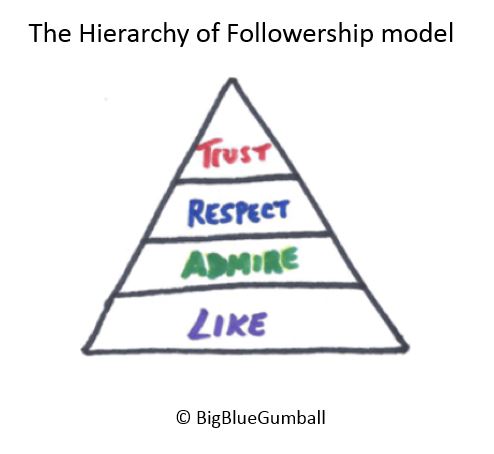
Sometimes as leaders we need to make tough decisions that not everyone’s going to like – or like us for. And, while it is nice when people admire us for our past accomplishments that’s all it is: a nice-to-have. Most importantly, we want people to respect us – our intelligence, our judgement, our integrity, etc. – and, ideally, to trust us.
But what is “trust” anyway?
In my leadership workshops and NYU “Leadership and Team Building” class, when we discuss the characteristics, traits, and qualities of effective leaders -- and my "Hierarchy of Followership" model (see below) -- the word “trust” inevitably comes up near the top of the list. But what do we mean by it?
That is such an often-asked question that out of the roughly one million entries in the English dictionary, according to Mirriam-Webster.com., “trust” is listed as the 102nd most commonly looked up word.
And when you look up the word “trust,” there are numerous definitions but they all basically have to do with “belief” and/or confidence. Belief that someone or something is reliable, good, honest, effective, etc., and the assured reliance on the character, ability, strength, or truth of someone or something.
From a word origin perspective, “trust” and “truth” have the same root, and are both related to the concept of “belief”:
- Do you believe that this person is telling the truth?
- Do you believe that this person will follow-through on what they say they are going to do?
- Do you believe that this person will follow-up with you as promised?
- Do you believe that this person will keep his or her commitments?
- Do you believe that this person can be held accountable for meeting or exceeding expectations?
- Do you believe, from a leadership perspective, that this person is someone you would voluntarily choose to follow?
How can YOU gain the trust of others?
The best way to gain others’ trust…is to be “trustworthy.” That’s obvious. But it means exhibiting the qualities that you would want in a job candidate, a teammate, or a leader:
- Be truthful
- Be transparent
- Be authentic
- Be accountable
- Take ownership
- Keep promises
- Follow up
- Follow through
- Do what you say
- And say what you do
So the next time you are deciding whether a person is someone you should hire, or whose leadership you would choose to follow, keep in mind that while it would be nice if you liked, admired, and respected them…it is most important that you trust them.
Similarly, while it is great to be liked, feels good to be admired, and an honor to be respected, ultimately, the key to building relationships and gaining followership is to build trust.
You Can Observe a Lot From Watching: Work & Life Wisdom from Yogi Berra
Tuesday, October 6, 2015 at 2:14PM 
In addition to having been one of the greatest ballplayers and most iconic baseball figures of all time, Yogi Berra, who passed away last week at the age of 90, was, of course, in many ways, almost as well-known for his wonderful way with words.
While, at first glance his famous quotes might appear perplexing (as well as hilarious – whether intentionally or not), when pried open they are found to contain wondrous pearls of wisdom.
Whether on the ballfield, at work, or in life, here are just a few ways in which we might benefit from practicing what Yogi preached…even if he didn’t actually say everything he said:
1) “It ain't over 'til it's over.” His most famous quote reminds us of two very important, but very different, things: One is to be careful not to declare victory prematurely. The other is that until something is official, there’s always still hope.
2) “Always go to other people's funerals; otherwise they won't go to yours.” There are too many people out there who are “takers.” As Wharton professor and author Adam Grant emphasizes in his excellent bestseller, “Give and Take,” it’s important -- and the right thing to do -- to reciprocate. Or, even better, simply to be generous.
3) “He's learning me all of his experience.” Said about the future Hall of Fame catcher, Bill Dickey, who was teaching the younger Yogi Berra how to play the position, encourages us to pass down our wisdom to others.
4) “I knew the record would stand until it was broken.” While congratulating the Cincinnati Reds’ Johnny Bench on breaking his record for home runs by a catcher, this one reminds us that records are made to be broken.
5) “If the world were perfect, it wouldn't be.” We often complain that people and things aren’t the way they’re “supposed to be”; but maybe the way things are IS the way it’s supposed to be…at least for now.
6) “If you can't imitate him, don't copy him.” People often get frustrated and discouraged when comparing themselves to others. But perhaps the only people we should be comparing ourselves to is ourselves. As Jeff Schwartzman the head of Learning & Development of Liquidnet (and my teaching partner at NYU) always says: “Measure yourself against your own yardstick.” It’s better to be the best YOU you can be, rather than a second-rate someone else.
7) “If you don't know where you're going, you might not get there.” Very simply, without a vision, a direction, a plan, and a goal, you probably won’t end up where you want to be.
8) “It gets late early out there.” Referring to the difficult sun conditions in left field at Yankee Stadium, this one reminds us of how quickly time often passes us by.
9) “Little things are big.” This one has so many possible meanings including the fact that a lot of time we focus on the big picture while losing sight of the details, and we often underestimate and undervalue the many smaller-sized and less-recognized contributions that various individuals make to a team’s or organization’s success.
10) “Ninety percent of this game is half-mental.” So often we focus on the technical skills necessary to do a job, but forget about how important the mental/emotional/human aspect is.
11) “You can’t hit and think at the same time.” A lot of times – when we’re delivering a presentation, interviewing, doing a task for which we’ve been trained, or swinging a baseball bat – our self-consciousness gets in the way...and we strike out. We second-guess ourselves, lose our confidence, stumble and fall. But when we’re well-prepared, confident, “in the zone,” and in a state of “unconscious competence,” we dramatically increase our chances for success.
12) “We made too many wrong mistakes.” Making mistakes is normal; but we need to make the “right” ones, learn from them, and not repeat them.
13) “What time is it? You mean now?” While Yogi was on a plane and didn’t know what time zone he was currently in when he was asked this, to me it’s a humorous reminder for us to try to be “in the moment.”
14) “Nobody goes there anymore. It's too crowded.” So often, especially in this digital age, we may end up following the crowd and jumping on the latest bandwagon. But maybe, sometimes, it might be better to just sit this one out.
15) “When you come to a fork in the road, take it.” Life is filled with choices and decisions – some minor and trivial, others future-determining and life-changing. As poet Robert Frost put it in his classic, The Road Not Taken, making choices is, ultimately, what life is all about. While we may sometimes decide to follow the crowd (see #14 above) or the path laid out for us by others, at other times we need to make our own choices, follow our own path, and take “the road less traveled”…i.e., the one which will make “all the difference.”
16) “Four. I don’t think I can eat eight” Yogi’s response when asked by a waitress whether he wanted his pizza cut into eight slices or four slices. Shows us that with some decisions, it’s just how you slice it.
17) “I really didn't say everything I said. Then again, I might have said 'em, but you never know.” This one speaks for itself.
To those of us who grew up with him having been around all our lives (especially if you were a Yankees fan growing up in New York!), Yogi’s passing last week really felt like losing a family member (in many ways he always reminded me of my Grandpa Sam -- same height and build, as well being an incredibly kind, warm, and genuinely friendly and generous man).
But even though he’s gone to that big ballpark in the sky, his baseball records, his Yogiisms, his smile – and his ability to make us smile simply by thinking of him – will continue to live on in the hearts of baseball fans forever.
All it takes is hearing one Yogiism, and it’s like déjà vu all over again.
Life Lessons, Yogi Berra, leadership, wisdom in Learning, leadership, personal productivity, success Team-BONDING Needs to Come Before Team-BUILDING
Tuesday, January 6, 2015 at 2:14PM 
Many corporate team building off-sites start out with good intentions, but end up being less than a Grand Slam event.
When you only have one chance to make it a success, how can you increase your odds of getting "a hole in one" -- on every hole?
I was recently asked in an interview, along with a number of other industry experts, "How do YOU create a team building event that is both fun AND effective?"
And this was my response:
"There is so much to say on the subject, as my company BigBlueGumball specializes in facilitating teambuilding workshops and off-sites for all types of organizations (boards, senior leadership teams, departments, project teams, etc.). And I teach a graduate course at NYU entitled, “Leadership & Team Building” as well.
Our company’s motto and approach is summed up and exemplified in the three words “Educate, Engage, and Excite” by making every team building experience high-energy, fast-paced, interactive, impactful, memorable, and fun – with the ultimate objective of setting a team up for success.
My philosophy is that “Team BONDING needs to come before Team BUILDING.”TM In brief, this means that before focusing on the work, we need to focus on the people.
Or, in other words, “We need to connect TO each other, if we want to work better WITH each other.
That includes doing engaging, interactive, fun – but not cheesy or clichéd! – team-based activities that help colleagues connect through getting to know one another just a little bit better.
We have a variety of different innovative exercises we draw upon to achieve this objective, and we customize every activity to each specific group based on a range of variables. We try to be innovative and do the unexpected, so no old-fashioned “catch-your-teammate-while-blindfolded” exercises for us. And if you’re looking forward to walking on hot coals, then you’ve come to the wrong place.
We use a variety of creative, professional methods and techniques – time-tested, research-based, and grounded in science – to help teams collectively come up with their own Guiding Principles, Team Charter, and/or Road Map that will immediately get them working together, defining roles and responsibilities, and starting to build trust and mutual accountability, while practicing the principle that (as Dale Carnegie put it), “People support a world they help create.”
In addition, when appropriate, we have a variety of simple assessments and exercises that help participants identify their own and one another’s preferred behavioral styles and personal preferences, for example, our Passion/Skill Matrix model, which supports the powerful notion (by management guru F.W. Taylor) that “People do best…what they like best to do.”
Other classic concepts and exercises we often incorporate into our team building workshops include Tuckman’s “Four Stages of Team Development” (forming, storming, norming, performing); Katzenbach’s “Six Team Basics”; Lencioni’s “Five Dysfunctions of a Team,” and more.
But, while based in the best of Harvard Business School-style models and methods, there is no “lecturing” in our teambuilding events: everything we do is experiential as we strongly believe, as the research shows, that people learn best by “doing.” And this has been proven to maximize the impact and effectiveness of the teambuilding experience so that when the event is over, and the teams eventually go back to work, they find that they will, going forward, work better together.
To sum up, the bottom line is that when a teambuilding event is done successfully, the outcome is – not just that they had a good time – but that they discover the truth in the classic maxim:
“As a T-E-A-M…Together Everyone Achieves More.”
corporate events, leadership, offsites, team builiding, teams, teamwork in Management, leadership Better to Receive: The Benefits of Being More Open to Feedback
Tuesday, November 25, 2014 at 3:26PM 
Why is feedback—whether it’s negative feedback or constructive criticism—so tough for most of us to take?
When we receive feedback that we don’t agree with, the tendency is to get defensive, to explain, to make excuses, to try to invalidate it, to deny it, to be offended by it, and even to resent the person giving it.
Continue reading below to to find out why that is -- and what we can do to be better at -- and make the most of -- the feedback we receive.
`````````````````````````````````````````````````````````````````````````````````````````````````
My recent post on the Feedback Sandwich technique prompted a few readers to ask questions like this:
Most articles on feedback focus on how to deliver it more effectively, but what about when you’re the one on the receiving end? Do you have any tips on how to be better at receiving feedback?
Ah . . . that’s a good one. And a tough one.
Speaking for myself, I love getting criticism and feedback, and am completely open to receiving it any time, any place…as long as it’s positive and complimentary. When it’s not . . . um . . . let’s just say that I’m not quite as receptive. Nor are most people.
Why is that? Why is feedback—whether it’s negative feedback or constructive criticism—so tough for most people to take? When we receive feedback that we don’t agree with, the tendency is to get defensive, to explain, to make excuses, to try to invalidate it, to deny it, to be offended by it, and even to resent the person giving it.
Your Brain at Work
I just finished reading an amazing book, Your Brain at Work, by David Rock, who explains the neuroscience behind why we react emotionally (and sometimes irrationally) to feedback that we don’t agree with or don’t want to hear.
In brief, our primitive brains are biologically wired to perceive feedback as a threat. Not to get too technical or neurological, but the amygdala—the fear center (referred to often by author Seth Godin as our “lizard brain”)—intuitively senses feedback as a threat and does anything possible to avoid it.
Rock compares the feelings that feedback triggers to that sick-to-the-stomach, hair-standing-up-on the-back-of-your-neck fear you might experience when walking alone down a dark, scary alley and hearing footsteps quickly sneaking up behind you. The sensation that we are about to be attacked. The feeling that our lives are in mortal danger. That’s what feedback can feel like. And when we receive negative feedback, we are, in fact, at risk, especially when we feel our confidence, our self-esteem, and our sense of self are under attack.
It’s the “fight, flight, or freeze” response in action. That’s why, when receiving negative feedback (or sometimes even positive and constructive feedback), we may respond by lashing out in defensiveness, running (or storming) away, or standing there, speechless, in shock and disbelief.
The Five Threats
David Rock's now-classic acronym, SCARF, clearly and effectively captures the five ways that feedback may serve to threaten our state of being:
Status: Getting feedback may feel as if we are being spoken down to and that our status or position relative to that other person is being threatened. A boss’s saying something as simple as, “I need to see you in my office” can trigger a feeling of heart-stopping terror . . . and make you feel two feet tall.
Certainty: When we receive feedback, especially if it is unexpected, it could create feelings of uncertainty and confusion. You thought you did such a great job on that presentation, but now the feedback has made you doubt your abilities and shaken your self-confidence.
Autonomy: When we receive feedback that puts into question the decisions and choices we’ve made, not only might we start to doubt our own judgment, but we may now fear that our freedom and empowerment might be taken away.
Relatedness: When we receive feedback from someone, it could impact our relationship with that person. “How could you say that? I thought you liked me. I thought you were on my side. Is that what you REALLY think of me?”
Fairness: Have you ever received feedback from someone and felt misjudged, misunderstood, or unfairly evaluated? If you’ve had the reaction “That’s just not fair. That’s not true. You’ve got me all wrong!” then you know how it feels to have your sense of fairness threatened.
So, now that we know WHY feedback might be perceived as a threat to our personal well-being, and that it’s a completely natural, neurological, biological response, what can we do about it?
Making Feedback Work for You
1. Try to keep an open mind, consider the source and the intention, and keep things in perspective. Don’t react or overreact; just take the feedback in. With the self-awareness you now have about WHY feedback feels like an attack, it might be a little easier (over time, with practice!) to be more open to receiving the feedback objectively.
2. Though it’s natural to react emotionally (especially when under stress), try not to get defensive. Even though it may feel like you are being attacked when the feedback’s coming from multiple people simultaneously, be open to the feedback, let it settle in, and then decide what you want to do with it.
3. Feedback is a source of knowledge. Though some things may be difficult to hear or to admit, keep in mind the value of knowing. If you were about to go on stage to deliver a presentation, and you had a “Kick Me” sign on your back, toilet paper stuck to your shoe, and your fly was open, wouldn’t you be better off knowing than not knowing? At least now you can do something about it.
4. When you get vague, general, ambiguous feedback (e.g., “You need to do much better next time”), seek out specifics. Ask for suggestions on how you might improve. Confusing feedback is worse than no feedback at all. You could even request that the person start with something positive before getting to the constructive criticism. Encourage them to use the Feedback Sandwich with you!
5. Change your mindset about feedback. Reframe it as a developmental opportunity rather than a criticism of you personally. Recognize that while the tendency (basic human nature) is to focus on the negative, it is equally important to validate your strengths and leverage what you’ve done well.
6. After receiving feedback, take some time to let it sink in, and think strategically on what to do with it and where to go from here. Remember: Unless something is a real emergency that is causing serious, immediate problems, you don’t have to change or fix everything—or anything—overnight! In fact, it’s almost impossible. Continuous improvement is an on-going process and a lifelong journey. And feedback is a mechanism that will help you to stay on course and moving ever-forward. Without it, how will you know how well you’re doing?
The Gift
There’s an old saying that “Feedback is a gift.” And like any gift we receive, we can choose to toss it in the trash, or we can appreciate the thought behind it. Perhaps when we unwrap that gift, when we have a chance to sit alone with it and ponder it, we’ll find a nugget of truth hidden somewhere inside that box; one that we need to seriously consider.
And, if that is the case, that feedback is, indeed, a gift, very often the best, and the only, response necessary, is these two simple words: “Thank you.”
The BigBlueGumball Passion/Skill Matrix: (aka "Do What You Love, Love What You Do: How to Be Happy and Successful at Work")
Wednesday, July 16, 2014 at 11:44PM 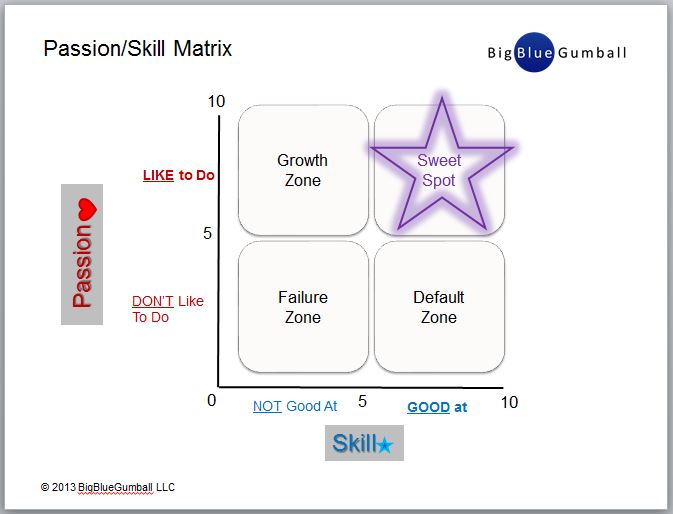
How much of your time at work are YOU spending in each quadrant?
------------------------------------------------------------------------------------------------------
“People do best, what they like best to do.”
That’s an old adage by Frederick W. Taylor, the original efficiency expert and management guru. Seems like common sense, doesn’t it? And yet, so many people hate their jobs. So why is that? What's going on?
The Passion/Skill Matrix may help to explain...
Think about your hobbies. You know, the things you do for fun. Whatever it is, whether it’s playing a sport, a musical instrument, practicing a craft, or whatever, you probably do it for at least one of the following two reasons: you’re good at it and/or you enjoy it. Otherwise, why do it?
If you love doing something, let’s say, playing the guitar or the piano or drums – even if you’re not very good at it – you’re going to pick it up and fiddle around with it, spending your spare time practicing, and watching and listening to others play, all in the hope of getting better. Even if you’re not that great and know you’re probably never going to play in a band, you still do it because it’s fun.
Similarly, if you’re good at something, even if it’s balancing your checkbook, you may not love doing it, but because you’re skilled in math and it comes quick-and-easy to you, you don’t really mind doing it. Or maybe you do?
So, what about something that you love doing AND you’re good at it? Now you’ve hit the magic bulls eye: your passions and your skills are in alignment! Let’s say you love playing tennis and you discovered years ago that you’re pretty good at it. Most likely, with this combination of passion and skill, you enjoyed watching tennis on TV to see how the pros do it, didn’t mind hitting a tennis ball against the wall thousands of times, and got a rush from playing every chance you got.
Over time, your skills grew. And as your skills grew, so did your confidence, which led to your taking on tougher challenges, practicing more, winning against better and better opponents, having fun competing and winning, and enjoying your increased success. No, you’re probably not going to play tennis in the U.S. Open, but you’re at a level that you are proud of and enjoy as you keep working on taking your game to the next level.
Now, what about when you are stuck doing something that you are not good at, and do not like doing? How successful do you think you are going to be?
Probably not very.
And, yet, this describes a lot of people’s jobs. So how does this happen?
Here’s how it happened to me: A number of years ago, I was out of work for a while when I was offered an amazing job as the VP of Business Development and head of the New York office for a leading west coast interactive agency. I was so honored to be hired by, and excited to be working for, this innovative company, and was looking forward to taking on the challenge of helping them to grow their east coast business.
But once the initial excitement wore off, the job itself ended up being much tougher for me than I ever expected. I started just around the time of the dot-com crash when finding new business instantly became tougher and tougher. And, unfortunately, I quickly discovered the hard way that I did not possess the abilities or the personality type required to succeed in this kind of role – especially in this type of market environment.
And, so, as time went on and as I continued to fail, my stress level rose, and I began to like this job less and less, until I could not even bear to get up for work in the morning.

If you’ve ever had a job that you didn’t like AND that you were not good at, you know what I’m talking about. I was set up to fail every day, through nobody’s fault but my own, and I just wanted out. Getting laid off, despite my feeling of loss as I loved the company and the people, actually ended up being a huge relief.
In almost every job, there are going to be aspects of your position that you enjoy doing, and things that you don't. And, there are going to be things that you are good (or even great) at, and things that you are not.
So, the key to success is finding the right balance.
For example, in my current role as head of a management and leadership consulting, training, and coaching firm, I love and feel that I’m pretty good at the consulting, training, and coaching part. What I don’t love, and am not that great at, is the actual running of the business itself (especially, the financial and administrative side).
So, what to do about it?
Taking a look at the Passion/Skill Matrix model, and thinking about YOUR job:
1. Make a list of all the different things you do on a regular basis; and then break them up into four categories: Things you are GOOD/GREAT at; things that you are NOT Good at; things that you LIKE/LOVE doing; and things that you DON'T Enjoy doing. If you like to quantify things, you can even score each one of these items on a scale of 1-10.
2. Next, draw a 4-box matrix like the one above, and place each of these items in one of the four boxes. For example, let's say you are good at and enjoy writing blog posts, put that in the upper right quadrant. If you like drawing, but are not that great at it, put that in the upper left. If you're good at math, but don't enjoy it, put that in the lower right. And if you hate cooking and are not good at it, put that in the lower left.
Now, lastly, let's look at the four-quadrant matrix to ask the "So what?/So that!" question: How can I use this model to be more successful?
Your SWEET SPOT - The things that you Like/Love and are Good At: If you have a lot in that box, you’re incredibly lucky! Try to spend as much time as possible on these things. This is where the intersection of your skills and passions lie, and where you have the greatest potential to leverage your strengths and go from good to great. When you're working on things that fall into this category, time flies, ideas flow, your energy is high, and you're in your element...so spread your wings and fly!
Your GROWTH ZONE - The things that you Like or Love to do, but are NOT great at...yet: This is a wonderful developmental opportunity! If you like something, or feel you have potential in this area, you are more likely to work at it by learning more about it, studying, practicing, and seeking out training and coaching. Einstein once said that, “Anyone who has never made a mistake has never tried anything new.” If you’re passionate about it, keep working at it. You never know how far you might get unless you try. And notice the powerful difference between saying, "I'm not good at that" vs. "I'm not good at that...yet." By simply adding that simple word "yet," you open up the world of possibilities.
Your DEFAULT ZONE - The things that you Don’t Like to do, but are Good At: Perhaps it’s something you used to like doing, or you just became the “go to” person by default because it comes naturally to you and everyone knows it. Well, this is a great developmental opportunity – for someone else! Here’s where you might be able to outsource, delegate, or take on the role of a mentor or coach to help someone else develop skills in this area. This is a win-win opportunity that will help someone else to grow while freeing you up to do other things...so you can spend more time "above the line" (i.e., in your Growth Zone and/or Sweet Spot).
Your FAILURE ZONE - And, lastly, the things that you Don’t Like (or Hate!) to do, AND are Not Good At: This is your “Failure Zone”…and you need to do whatever it takes to get out of this box as soon as you can. Again, we all have aspects of our jobs that we may not love, but if you are spending more than 25% of your time in this box, you are setting yourself up for a whole lot of pain and suffering. And, to be honest, if you’re in a job that you really, truly don’t like and that you are really, truly not good at, you’re not doing your employer any favors by staying in this role. Sometimes we stay just for the paycheck, but it’s really hard to sustain that over the long haul. And it’s ultimately going to take its toll on your physical and mental health. So, whatever it takes, you need to try to get yourself out of this box.
Although...one other important thing to think about regarding your Failure Zone: Have you ever considered that this Zone might, potentially, be your greatest area of opportunity? You identify things as belonging in your Failure Zone because you are not good at it and don't like it. But think about it this way: What if you TRIED...and got better at it? And once you got better at it, you didn't hate it quite as much. And now that you don't hate it as much, you are willing to try it again, finding that, with experience, you find youself inching your way up, in this area, out of the Failure Zone until it now -- magically -- resides in your Growth Zone! From there, once you've broken through the box you had put yourself in, could this potentially become part of your Sweet Spot? Only time will tell...but it is entirely within your power to make it happen...if you are willing to open your heart and your mind to the world of possibility. Think about it: How many of your Sweet Spot skills were once part of your Growth Zone, or even your Failure Zone? My guess: Probably MOST of them!
Lastly, as Dan Pink writes in his book Drive and as he speaks about in this amazing RSAnimate video, people are happiest and most productive when they have three key, intangible things: Autonomy, Mastery, and Purpose. If you are lucky enough to find a job where you spend most of your time with the freedom and flexibility to make your job your own (autonomy); in an environment that allows you to grow and develop into the best you can be (mastery); while doing work that matters (purpose), that’s when you’ve got it made.
As they say, “If you love what you do, you’ll never work a day in your life.”
END
BBG, Engagement, Management, Passion/Skill Matrix, Skill, coaching, leadership, motivation, passion in Careers, Management, leadership