tagged  coaching, personal productivity, planning, summer in Careers, Coaching, Effectiveness
coaching, personal productivity, planning, summer in Careers, Coaching, Effectiveness 

Friday, June 24, 2016 at 6:04PM 
The classic Gershwin song reminds us each year around this time that it’s “Summertime, and the livin’ is easy.” While those “fish are jumpin’,” the pace at work tends to slow down; the office dress code tends to get more casual; bosses, co-workers, and clients disappear on vacation; and most everyone tries to sneak out early on Fridays.
So, you’re thinking: Why not join the club, chillax, and shift into cruise control for the next couple of months?
But instead, what if, this summer, you decided to shift gears and do the opposite!
While everyone else is out getting their second Mister Softee or third iced coffee of the day, why not carpe the diem and take at least some of this downtime to do some of those things that you’ve been putting off all year long? That is, instead of cruising through the summer and then wondering where the time went, why not put the pedal to the metal, and take advantage of these lazy, hazy, days of summer to get ahead.
How? By – in addition to, of course, allowing yourself to take some well-earned and much-needed time off for yourself – you may want to consider dedicating at least a few of those dog days of summer – the period between the Fourth of July and Labor Day – to focus on these four incredibly imporant and impacful career-enhancing activities:
The Time Management Matrix model I mentioned in a previous post (“Start the New Year Off Right with 7 Simple Productivity and Time Management Tips“) demonstrates that we spend most of our time in either Quadrant 1 (Urgent & Important tasks) or Quadrant 3 (Urgent and Unimportant tasks). For good reason, it’s often referred to as “the tyranny of the urgent” because we let external demands and time constraints dictate where and how we spend so much of our time.
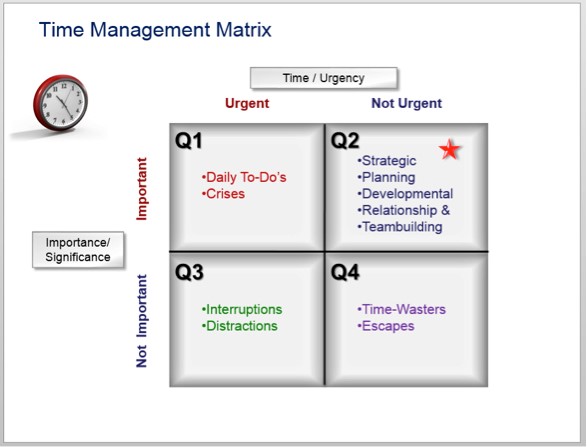
But with things slowing down a little and often with fewer Q1 & Q3 fires to put out, summertime just might be the right time to focus on Q2 (Important, but Non-Urgent tasks and projects)…and even allow us to spend some Q4 downtime (Unimportant, and Non-Urgent) on ourselves.
So regarding those four developmental areas I listed earlier, which quadrant do they fit into? Yes, Quadrant 2!
Q2 is where the bigger picture, longer term, strategic, and developmental things happen. So, developing ourselves, developing our relationships, developing our people, and developing our teams are four high-payoff activities that often end up on our Wish List rather than on our To-Do List. Why? Because, by definition, though they are of high importance, they simply are not “urgent”…and it is the urgent and time-sensitive things that tend to command our attention and dictate our calendars, often leaving us with no time, or energy, to spend in the all-important Quadrant 2.
And what about Q4 – the unimportant and non-urgent? Well, we cannot live by work alone! There is definitely a need to recharge and refresh ourselves mentally, physically, emotionally, and spiritually. And summertime is the perfect time to try to carve out some time to do that. After how hard we work throughout most of the year, don’t we owe it to ourselves to take advantage of this downtime…and the beautiful weather? And, though Q4 activities are often categorized as “Time-Wasters and Escapes,” as the saying goes, “Time you enjoy wasting, is not wasted time.”
YOUR SUMMERTIME Q2 & Q4 TO-DO LIST
So, to help you seize the day and develop yourself, your relationships, your people, and/or your team this summer, here are just a few of a potentially unlimited number of possible suggestions that you may wish to consider adding to your summertime To-Do list:
[1] DEVELOP YOURSELF
While racing to get your work done throughout the year, it’s very easy to forget about working on yourself. So make the time and take the time this summer to get organized and to create processes and systems that will help you to be more efficient and effective and productive. Here are just a few suggestions to help you develop yourself this summer:
[2] DEVELOP YOUR RELATIONSHIPS
Initiatiating conversations with your co-workers will not only increase your knowledge, but will help you to develop and strengthen those relationships. As the saying goes, in the business world it’s not just what you know…but who you know – as well as who wants to know you. And as the best way to be seen as “interesting” is to BE “interested,” seek to ask questions and make an effort to get to know people on a sincere, genuine, and human level. A few ways to build your network and deepen your relationships this summer:
[3] DEVELOP YOUR PEOPLE
The biggest objection I get when trying to sell clients on my training services is not “We don’t have the budget,” but “We just don’t have the time.” Unfortunately, the reality is that “NOW” is never a good time. So if you sincerely want to develop your people, you simply have to make the time, and the commitment, to do so. If you truly want to attract, retain, engage, and motivate your people, one of the best ways to do that is to invest in their personal and professional development. And summertime just might be a great time to squeeze in some training, coaching, mentoring, and more:
Btw, while some managers ask, “What will happen if we invest in developing them and they leave?” the other question to consider is, “What will happen if we DON’T, and they stay?”
[4] DEVELOP YOUR TEAM
Developing each individual in your organization is the first step, but when you develop people to become a more high performing team, you’ll find that as a T.E.A.M. – Together Everyone Achieves More. As I wrote in my post, “Team BONDING Needs To Come Before Team BUILDING,” to build a championship team takes time and attention. Time that you may be able to take advantage of during the summer:
While there are a million more possibilities, I’ll stop here. If you have other ideas, please share them with us!
In closing, as the inspirational magnet on my refrigerator advises: “Do something today that your future self will thank you for.” Which implies that if you do just some of the things listed above, your “September Self” will appreciate and thank your “Summer Self” for setting you up for a successful remainder of the year.
And again, while you’re busily making progress on your Q2 to-do list, remember to also take some Q4 time to reward yourself…especially if or when you hear that hypnotic and mesmerizing Mister Softee theme song calling your name.

coaching, personal productivity, planning, summer in Careers, Coaching, Effectiveness Saturday, May 21, 2016 at 5:36PM 
It’s the classic Catch-22 situation: You can’t get a job or change careers without the necessary experience … but how are you supposed to gain experience if no one will give you a chance?
The answer: find an internship, temp job, or consulting gig! And this advice applies not just to recent graduates, but to ANYONE at any age, or at any stage of their career.
Doing an internship, taking a temp job, or getting project work will give you practical, real-world experience, get your foot in the door (or get it back in the door) of the working world, lead to your developing some new relationships and new skills, and help you to figure out what it is that you really want to do and (equally important) what you don't.
Earlier in my career, as well as at various times when I was between jobs, I worked at a series of (unpaid) internships and (low-paying) temp jobs. Some of them were interesting, most were pretty boring, and others were completely torturous.
But without them I would, most likely, not be where I am (or who I am) today.
For example, during the summer between graduating with my B.A. and finishing up my master's, I did an unpaid three-month internship as a researcher at NBC. It actually cost me money to work there, as I had to pay for my commute and lunch every day, not to mention the costly dry cleaning bills.
But although doing that internship had some downsides, it had many more upsides: I gained valuable work experience and discovered some of the things I liked to do and was good at — as well as a number of things that I didn’t and wasn’t. I made some useful contacts, gained some invaluable work experience, built my confidence, got a rush of excitement walking into 30 Rock every day, and was now able to put “NBC” on my resume.
A couple of years later, after moving out to L.A., a series of eight temp jobs in eight different departments over eight weeks at Disney ultimately led to an amazing administrative assistant job in tv comedy program development, working for a writer/producer on the legendary Burbank studio lot.
Looking back, I can honestly say that each and every one of my internships, temp jobs, or consulting gigs turned out to be, in one way or another, an impactful and memorable stepping-stone in my career.
And they left me with some valuable, life-long lessons that can be summed up in these four simple phrases: Look, Listen, & Learn; Do & Try; Ask Questions, Especially "Why?"; and Build Relationships Now:
1. Look, Listen, & Learn
When you start doing something you’ve never done before, in work or in life, EVERYTHING is new: the people; the place itself; the policies, processes, and procedures, etc. So be a sponge! Take it all in. Every interaction, every conversation, everything you see, hear, and feel –- seek to look, listen, and learn.
Be alert. Be aware. Be self-aware! Look around you — up, down, and across. Step outside yourself. Try to see things from others' points of view. Seek candid feedback. Look for best practices. And worst practices. Take a mental (or written) inventory of Do’s & Don’ts. Absorb the culture. Engage with the entire experience. And maintain an open and positive attitude. Make everything that happens, every day, a memorable experience and a teachable moment.
While your time in this position may only be brief, what you learn, both positive and negative, could last a lifetime if you just pay attention. And, even though it may be far from your "dream job," as in the Robert Frost poem “The Road Not Taken,” you never know where it might lead.
2. Do & Try
It’s one thing to learn by looking and listening. But people learn most -– and learn best -– by DOING. So seek to do, and to try to do, as much as possible. Stretch yourself beyond your comfort zone. Take some risks. Raise your hand. And be willing to get your hands dirty, even though they may sometimes end up getting a little battered and bruised. It’s all part of the game.
Don’t expect to do everything right, or to be perfect the first time out. “Trial and error” is a common phrase for a reason. That's why pencils have erasers. And, as Einstein said, “Anyone who has never made a mistake has never tried anything new.” The key is to have the confidence to do and to try and to fail. You are going to make some mistakes, so just expect that...and accept that. Knowing this in advance will make it much less painful when (not “if”) it happens. And if and/or when it ends.
3. Ask Questions, especially “Why?”
It is said that knowledge comes not from answering questions, but from questioning answers. So never be afraid to ask who, what, when, where, how, and (most important!) why.
You aren’t expected to have all the answers. So leverage the knowledge and experience of those who’ve been down this road before. Seek advice, feedback, coaching, and mentoring. Everyone had to start somewhere, and now it’s your time, and your turn. Be curious. Explore. Seek to understand. Dig deeper. And question everything. That’s the only way to learn and to grow.
I remember asking the guy who hired me for that Disney job why he chose me over all the other candidates he interviewed -- even though I knew that a few of them had better resumes than mine. His simple and straight-forward reply: “Because you asked good questions.”
4. Build Relationships Now
We’ve all heard the expression, “It’s not WHAT you know, but WHO you know.” But, in reality, "who you know" is not as important as "who wants to know you"! You definitely need to know stuff – we don’t want to minimize that. And you do want to meet and get to know as many people as you can. But the key to success in building relationships is getting people to want to know you. And that all comes down to building personal relationships, as well as developing your personal brand.
Someone may have the highest intellectual intelligence in the world, but without emotional and social intelligence -– the ability to know ourselves, and successfully interact with others and develop relationships -– we are, most likely, not going to get very far in the business world.
So be seen. Be heard. Seek to become an "SME" ("subject matter expert") in your area of interest. Be passionate, and demonstrate that passion. Be interesting, but also be interested. Be recognized as someone who can add value. And someone whom others want to know.
But remember that when it comes to building relationships – in work, as in life – it's about quality, not quantity. Seek to form real, genuine, authentic personal connections. Be generous. If you seek to give more than you take and get, it will, (hopefully) eventually come full circle. And, if not...well, it's just the good and the right thing to do anyway.
Lastly
One final thing to remember: While some internships and temp jobs and consulting gigs are stimulating and engaging and exciting, others (many) may not be. The key is to frame your thinking as, “I am going to try to make the best –- and the most -– of my current situation, knowing that it is just one stepping-stone along what will most likely be a long and winding career path.”
And keep in mind that, despite that common metaphor, most careers tend not to be a straight "path," but more of a "roller coaster" of ups and downs, emotional highs and lows, and unexpected twists and turns.
If you think of your career as a journey, and try to make the most of the trip, you’re more likely to successfully reach your desired destination...and to enjoy the ride along the way.
*For more on this topic, please see my previous posts:
"Spanning the Decades: Career Advice for Every Age and Every Stage"
"Are You Looking for a Job, a Career, or a Calling?"
Saturday, April 30, 2016 at 3:40PM 
One of my NYU students was facing a dilemma: A few chapters into a highly-recommended, award-winning, bestselling business book, she realized that she found it to be a boring and uninteresting waste of her limited and valuable time. Meanwhile she had a pile of other, much more engaging and tempting titles sitting right there on her nightstand calling her name. She was excited about diving into one of them, only to find that when she put the boring book aside to embark on a new reading adventure, she suddenly and inexpicably found herself feeling extremely guilty.
Why?
As she put it, “The culture where I come from is really uptight about winning. People who quit are looked upon as ‘failures’. And, so, quitting this book translated into a failure on my part. And this feeling of guilt comes in whenever I don’t finish something.”
“Always finish what you start.”
“Don’t be a quitter.”
“No pain, no gain.”
“Never, ever give up.”
“Winners never quit, and quitters never win.”
“Quitters are losers.”
“Many of life’s failures are people who did not realize how close they were to success when they gave up.” (Thomas Edison)
“I hated every minute of training, but I said, 'Don't quit. Suffer now and live the rest of your life as a champion’.” (Muhammad Ali)
“If you quit ONCE it becomes a habit. Never quit!!!” (Michael Jordan)
For those who grew up with parents, teachers, coaches, and/or other authority figures and motivational speakers drilling these mantras into our heads, no wonder we feel guilty when we decide not to continue with something!
But when is it ok to quit? How do we know when it’s better to cut our losses and move on? What about “sunk costs” that cause us to dig ourselves into an even deeper hole? How do we decide when to drop something and when to persevere? How do we determine whether to give something (or someone) a second or third or tenth chance vs. when to say, “that’s it…enough is enough”?
And, is there a difference between “quitting” and “being a quitter”?
Confession: I Am A Quitter
I’ve quit jobs that weren’t working out, and I’ve ended relationships that were dysfunctional. I’ve left many books unfinished, and I’ve walked out of many a bad play or movie. And I quit piano lessons when I realized that I wasn’t really very good. I recently quit eating foods loaded with sugar and carbs, and replaced them with nuts, fruits, and vegetables. And I quit reading the New York Times while laying on my couch, and instead now read it everyday while walking for 30 minutes on the treadmill.
So you can see where I’m going with this: When it comes to “quitting,” it’s all about context, and how you define and frame it.
In his classic leadership book, “What Got You Here, Won’t Get You There,” legendary management guru Marshall Goldsmith explores “the 20 Workplace Habits You Need to Break.” In other words: there are unproductive and counterproductive behaviors that successful people need to QUIT doing in order to enable them to become even more successful, and leaders are often successful not because of how they are, but in spite of how they are. And, so, to get from “here” to “there” they may need to “quit” doing the things that may be holding them back.
While it is admirable to keep on keepin’ on, there is no shame in movin’ on if what you’re doing just isn’t working for you anymore. If you are not engaged, if you are unhappy, if you have given it your all and see little or no possibility of sunnier skies, then, perhaps, the best choice you can make might just be to make a change. As you get older (and, hopefully, wiser), you come to realize that life is short: Too short to waste on books, or movies, or tv series, or projects, or jobs, or relationships that you no longer find valuable. The key, and the challenge, is that – though you can seek out others’ input, advice, and opinions – when it comes to your life, you are the only one who can make the determination on whether to pass or to play.
It often helps to think about the fact that ending something negative – though leaving a void – creates the time and space for the start of something new. And that it’s hard to start something new while our cup is full or when we’re tenuously hanging onto the past.
So I’m not talking about quitting on a person who is relying on you, walking out on someone, leaving a project half-way done, or storming out of the office while crooning the old country song, “Take this job and shove it, I ain’t workin’ here no more.” I’m talking about when you reach a point where, after much thoughtful consideration and deliberation you’ve made the well-thought-out, considered decision that it’s time to move on.
Why Didn’t You Just Quit?
As I wrote about in a previous post (“A Love Letter to All of my Horrible Bosses”), earlier in my career I worked at one of the tv networks as an administrative assisstant for an abusive, sadistic, insane and maniacal boss who treated me horribly on a daily basis, including, one time, throwing a box of pens at my head because they weren’t the kind she liked. (They were medium point; she wanted the fine point.)
When people hear these stories about her – after laughing in disbelief and horror – they typically ask, “Why didn’t you just quit?” This question can best be answered in the following old joke:
“This guy works at the circus and his only job is to clean up after the elephants. All day long, day after day, his job is, literally, nothing but shoveling sh*t. And, then, after work every night he would meet up with his friends at the bar and bend their ears for hours complaining about it. Finally, fed up with the endless complaints and unable to hear about it anymore, his best friend exclaims, “If you hate it so much, then why don’t you just quit???” To which he replies, “What…and leave show business!”
The Learning/Enjoyment Matrix
Going back to my student’s story about the feeings of guilt associated with “quitting” her boring book in order to pick up another, more interesting one, it got me thinking about it in this way:
Ideally, it’s great when we’re able to spend our valuable time doing what we love and loving what we do. When we’re “Learning & Loving it,” time flies, we’re truly engaged, in a state of “flow” or “in the zone,” we can’t wait for it to start, and hate for it to end. This could refer to a book, a class, a movie, a tv series that we’re binge-watching, a project, a job, or even a relationship.
Sometimes, though – let’s keep using the book example – we’re not, necessarily learning anything monumental from it, but we’re enjoying it. And there’s absolutely nothing wrong with a little mindless entertainment, escapism, and fun.
But what about when we’re learning, but not, necessarily, enjoying it? Continuing with the book, maybe it’s taking a tremendous amount of effort to even pick it up again, a challenge to understand, and maybe even an exhausting struggle to get through every page. And, yet, little by little, you are learning something. Do you keep forging ahead…or do you quit?
Lastly, what about when you’re engaged in something where you are neither learning anything nor enjoying it? What then? And, what if it’s not a $14.95 paperback we’re talking about…but a hobby you were trying out that you’ve made an investment in, a project you’ve been working on, a relationship you are involved in, or…even your current job? Then what?
Again, there are no easy answers. And, again, only you can decide. But, perhaps framing your situation using this matix will help you to think things through.

Playing Quit & Seek: A Few Questions to Consider
When should you quit your job…and seek out a new opportunity?
When should you quit that bad relationship…and seek out a better one?
When should you quit a bad habit…and replace it with something more healthy and productive?
When should you quit complaining about problems…and start coming up with solutions?
When should you quit venting…and start in-venting?
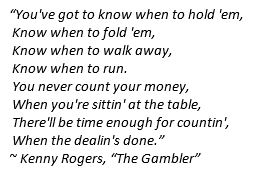
How do you know whether to quit while you’re ahead (i.e., knowing when to hold ‘em, and when to fold ‘em)?
How should you quit (if or when the time comes, what’s the right way or the best way to do it)?
Why are you quitting (is it the right decision, and are you quitting for the right reasons)?
Who can you rely on and trust for counsel, advice, and support?
Have you weighed the pros and cons of quitting vs. persevering?
Have you explored all your alternatives?
Are you giving up too soon?
Or have you already stayed too long?
Have you given it your best shot?
Is it time?
The best distinction I’ve heard between “quitting” and “being a quitter”
In closing, quitting is never easy. It is often an emotional and wrenching and potentially-confusing decision with numerous variables and unlimited pros and cons. And though making the decision to quit something is a tough one, the decision to not decide can be equally as tough. As mentioned in my last post (“It’s Leap Year…So Why Not Take That Leap!”), I’ve found that being stuck in limbo is worse than anything. As the psychologist William James famously wrote, “There is no more miserable human being than one in whom nothing is habitual but indecision.”
Perhaps this inspirational quote will help to reframe what “quitting” is about, and help you to decide what road to take or what move – if any – to make:
“Quitting is not giving up, it's choosing to focus your attention on something more important. Quitting is not losing confidence, it's realizing that there are more valuable ways you can spend your time. Quitting is not making excuses, it's learning to be more productive, efficient and effective instead. Quitting is letting go of things (or people) that are sucking the life out of you, so you can do more things that will bring you strength.” ~Osayi Emokpae Lasisi, author of “Impossible Is Stupid”
To sum up, perhaps by ridding ourselves of the mindset that quitting is for losers, we will realize that sometimes, quitting is exactly what we need to do…in order to win.
Careers, Decision Making, Quitter, Quitting, confidence, job search, leadership in Careers Wednesday, August 12, 2015 at 3:37PM 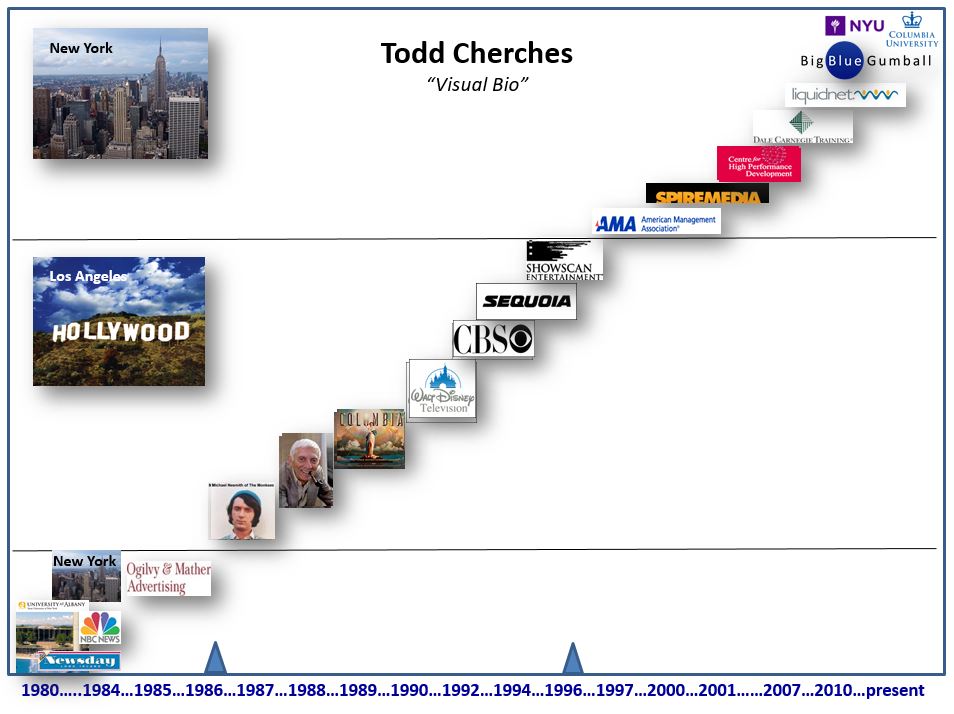
As we all know, the traditional resume is an important and essential part of the job search process — a way to efficiently and effectively represent and communicate your career history on a page or two.
But after a hiring manager or recruiter has sorted through thousands of resumes and interviewed hundreds of candidates, your text-based, bulletpoint-filled black and white resume can easily get lost in the shuffle and buried in the pile (e.g., “I forget… which one was the guy who used to work for Disney and CBS?”).
This is why I recommend that you consider something new and innovative: a visual bio!
What is it? Put most simply, it's a colorful, visual version of your text resume.
Of course, it doesn't take the place of your traditional resume. But it is a great way to supplement it. It's a personal branding and marketing piece that you can take along on your interview to use as a visual roadmap while telling your story, and then leave behind as a powerful, colorful, visual reminder of who you are -- and why you're the right person for the job.
Not only will it assist you in clearly articulating your career history but -- as a picture is worth (at least) a thousand words -- it will give you an opportunity to demonstrate your creativity -- and enable you stand out from the crowd.
Wednesday, February 11, 2015 at 5:40PM 
When is it ok to accept a job that is not your "dream job"...and how can you make the most of it?
Check out what Todd had to say in this real-life case study on Forbes.
Careers, Forbes, Job Hunting, Todd Cherches, bigbluegumball, jobs in Careers